
Some of it is arithmetic on a transcript. Some of it is a model. And several headline metrics are not per-rep at all, by the vendor's own documentation.
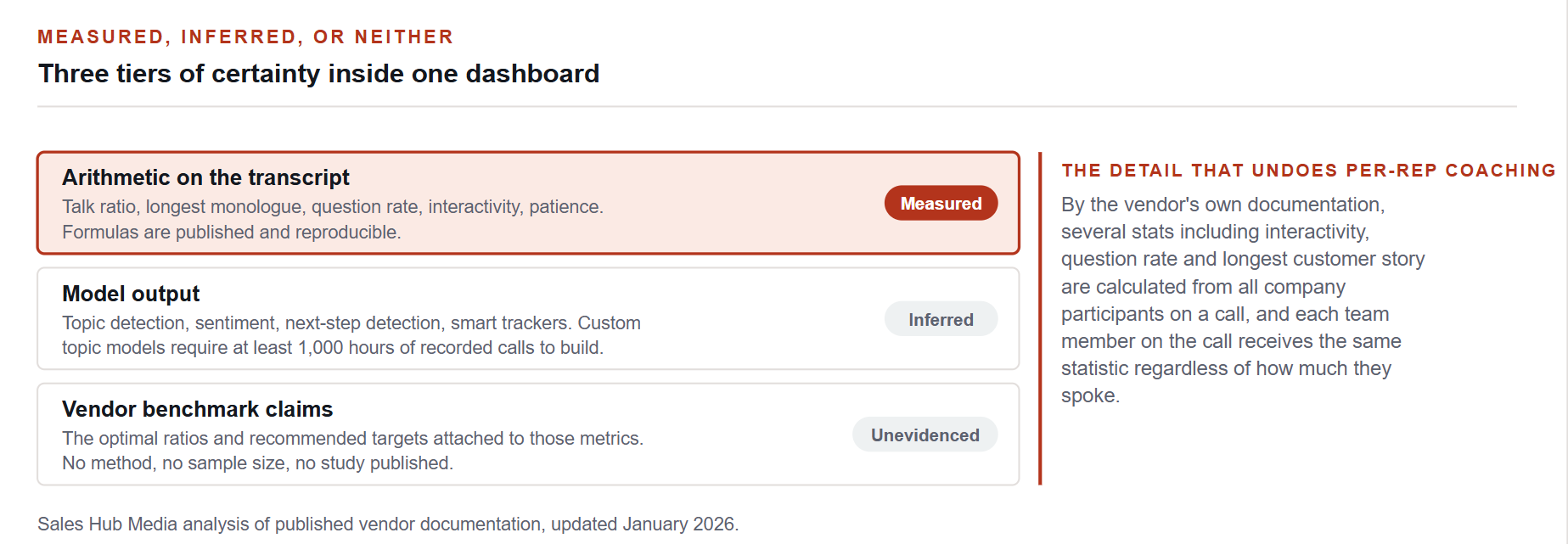
Based on the published metric definitions of a leading conversation intelligence platform. The distinction is not visible in the product interface, where all three appear side by side as equivalent numbers.
Conversation intelligence sells a simple promise: record the calls, and the software will tell you which behaviours win. The dashboard delivers a set of numbers that look equivalent. They are not.
Three different things are presented side by side. Some numbers are arithmetic performed on a transcript and are exactly as reliable as the transcription. Some are model outputs, with all the uncertainty that implies. And some are not measurements at all, but vendor benchmark claims attached to the measurements, with no published method behind them.
What is genuinely measured
The strongest thing to say about this category is that at least one major vendor publishes its formulas, which is more than most sales technology does. Talk ratio is the sum of the percentage of time a team member spoke divided by their total number of calls. Longest monologue is the sum of the longest monologue per call divided by the number of calls.
Interactivity is the number of times the conversation switched back and forth between company and external participants, with short interruptions such as yes or right not counted, computed as switches per five-minute interval, averaged, and capped at 10. Patience is the median transition pause divided by the number of calls. Question rate normalises questions to a one-hour conversation: five questions in a twenty-minute call becomes fifteen an hour.
All of that is checkable. If you disagree with a number you can work out why.
What is inferred
Topic detection is a model. The base model detects a small set of standard topics, and custom topic models require at least 1,000 hours of recorded calls in a workspace and have to be built with the vendor's own team. In aggregate team statistics, a topic must appear in at least four calls to be counted at all, and below that it reads as not available.
Keyword trackers are deterministic string matching and behave predictably. Smart trackers are AI and, in the documentation we reviewed, are English-only. Tracker mentions are calculated only for calls the team member hosted.
None of that is a criticism. It is a description of a boundary that does not appear in the interface.
The claims that are not measurements
The most widely quoted number in sales coaching is that the highest-converting talk-to-listen ratio on B2B sales calls is about 43:57, with the rep taking the 43. It appears in customer-facing documentation as established fact.
There is no published method behind it. No sample size, no definition of converting, no time period, no description of how the analysis was performed. The same is true of the recommended thresholds attached to the other metrics: no more than two and a half minutes of monologue, an interactivity score of five or more, a pause of between 0.6 and 1 second, eighteen or more questions an hour. Each may well be derived from real data. None of the derivations has been published.
A vendor that publishes its formulas and withholds its studies is telling you it can be audited on arithmetic and not on conclusions. That is worth knowing before you performance-manage anyone against the conclusions.
The detail that undermines per-rep coaching
This one deserves to be much better known. In the vendor documentation we reviewed, the calculations for several statistics are based on all company participants in a call, and each team member on the call gets the same statistic regardless of how much they spoke. The listed metrics include longest customer story, interactivity, question rate and all three responsiveness measures.
On any multi-rep call, and in most enterprise deals that is most calls, a rep's question rate is not their question rate. It is the call's question rate, assigned to everyone who attended. Coaching an individual on that number is coaching them on someone else's behaviour.
Statistics are also updated twice a day rather than in real time, which matters if anyone is making a same-day intervention on the basis of one.
The evidence base, honestly described
We looked for peer-reviewed or otherwise independent research establishing that these measures predict sales outcomes. We found very little. The academic literature on computational analysis of B2B sales calls exists but is thin, and nothing we located tests the specific coaching heuristics these products ship with.
That does not mean the heuristics are wrong. It means the only party that has run the analysis is the party selling the product, and it has not published the analysis. Treat every optimal ratio in this category the same way until a method appears.
The legal exposure is larger than the coaching question
Recording is where this category carries real risk, and it has moved in the last year.
The federal baseline in the United States is one-party consent under 18 U.S.C. 2511(2)(d). Several states require all-party consent. California Penal Code 632(a) makes it unlawful to record a confidential communication without the consent of all parties, with 632(c) excluding communications where the parties may reasonably expect to be overheard or recorded. That exclusion is the main battleground.
The provision that makes this commercially serious is Penal Code 637.2. It provides for recovery of the greater of $5,000 per violation or three times actual damages, and subsection (c) states that it is not a necessary prerequisite that the plaintiff has suffered, or be threatened with, actual damages. No injury requirement, statutory damages per violation, and a recording tool that joins thousands of calls.
That is the engine behind In re Otter.AI Privacy Litigation in the Northern District of California, docket 5:25-cv-06911, filed 15 August 2025 before Judge Eumi K. Lee, which consolidated several separately filed cases with seven named plaintiffs. We were not able to confirm the current procedural posture from the public docket, so we are reporting the existence and consolidation of the case rather than any ruling.
Outside the United States, the position runs through data protection rather than wiretap law. The UK's PECR guidance is currently under review following the Data (Use and Access) Act 2025, which came into law on 19 June 2025.
What to ask, and what to fix
Which numbers on this dashboard are formulas, and which are model outputs? Get it in writing.
Which statistics are calculated per person, and which are calculated per call and assigned to everyone present?
What is the study behind each recommended threshold? Ask for the sample size and the period.
How does the product obtain consent, and which mechanism applies in which jurisdiction? Pre-call notice, a consent page and an audio prompt on join are the three mechanisms in common use.
Who decides which calls are recorded in all-party consent states, and what happens when an external participant objects mid-call?
If we performance-manage against these metrics, can we defend the derivation in an employment dispute?
The category is useful. Call recordings are genuinely the richest coaching data a sales organisation has, and searching them beats not searching them. The mistake is treating the dashboard's benchmark line as a finding rather than as marketing, and treating the recording itself as a technical decision rather than a legal one.
This is reporting on rules as they stood at the date of publication. It is not legal advice. Requirements differ by jurisdiction and change. Take qualified advice on your own circumstances.
References
Every figure and legal citation in this article is drawn from the sources below. Where an instrument is proposed rather than in force we say so in the text.
Gong, Analyze team performance, published metric definitions and formulas, updated 7 January 2026. https://help.gong.io/docs/analyze-team-performance
Gong, Understanding the AI Topic Tagger, updated 28 January 2026. https://help.gong.io/docs/understanding-ai-topic-tagger
Gong, Call recording and consent settings, updated 7 July 2026. https://help.gong.io/docs/call-recording-and-consent-settings
United States Code, 18 U.S.C. 2511, interception of communications. https://www.law.cornell.edu/uscode/text/18/2511
California Legislature, Penal Code section 632, eavesdropping on or recording confidential communications. https://law.justia.com/codes/california/code-pen/part-1/title-15/chapter-1-5/section-632/
California Legislature, Penal Code section 637.2, civil remedy and statutory damages. https://law.justia.com/codes/california/code-pen/part-1/title-15/chapter-1-5/section-637-2/
Information Commissioner's Office, Guide to PECR, under review following the Data (Use and Access) Act 2025, page dated 20 August 2025. https://ico.org.uk/for-organisations/direct-marketing-and-privacy-and-electronic-communications/guide-to-pecr/
How we work. This article was researched and written by the Sales Hub Media editorial team. We do not republish press releases. Every number and legal citation is checked against a primary source, which is named and linked above. Where an instrument is proposed rather than in force, we say so. Corrections are made openly on the article itself, never by silent edit. If you believe something here is wrong, write to info@saleshubmedia.com and tell us what and why.
Filed under Revenue & Conversation Intelligence · Get The Weekly Brief