
The term's own media property now redirects to a page that does not use it. That is worth knowing before you build a strategy around the label.
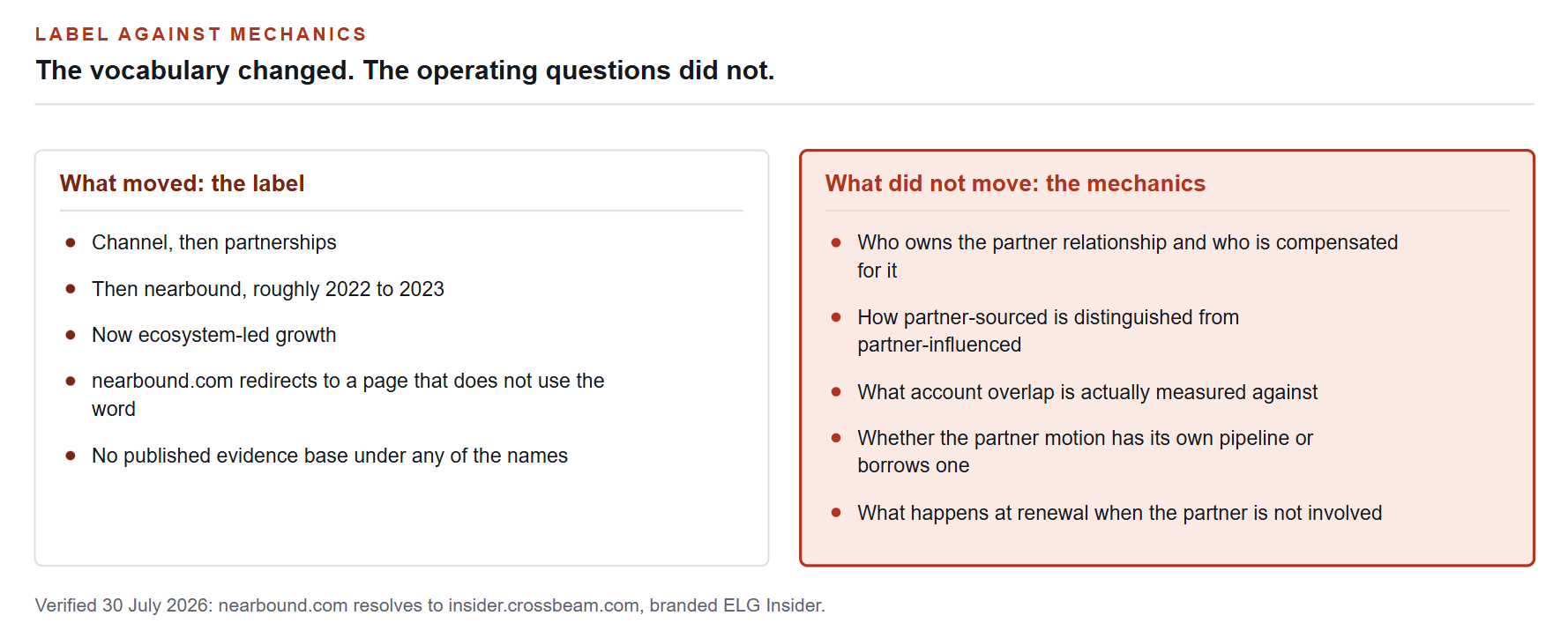
The marketing language around partner ecosystems has turned over twice in four years. The questions a partner organisation has to answer have not changed at all.
We set out to write a straightforward piece on the nearbound operating model: staffing, compensation, measurement. The first thing we checked changed the article.
The domain tells the story
As at 30 July 2026, nearbound.com redirects to insider.crossbeam.com. The destination is branded ELG Insider, subtitled ecosystem-led growth insights for B2B leaders. Its meta description sells the Crossbeam Insider Newsletter and ecosystem-led growth. The word nearbound does not appear in the page title, the description, or any Open Graph tag. The explainer page at nearbound.com/what-is-nearbound returns nothing.
The commercial entity that built the term's media property has rebranded away from it. Writing about nearbound as a live category in mid-2026 means writing about a label its own originators have stopped using.
This is not a criticism of the idea. It is a warning about building a function, a job title or a board narrative on vocabulary that turns over every two years while the underlying work stays the same.
We should be precise about what we could not confirm. The attribution commonly given for the term, to a figure associated with Reveal and PartnerHacker around 2022 to 2023, we could not verify against a named dated source, so we are not reporting it as fact.
The evidence base, or the absence of one
We looked for a verified figure for partner-sourced or partner-influenced revenue share in B2B software, with a named publisher, a sample and a date. We did not find one. The same applies to partner team size, partner programme economics and typical referral or revenue-share rates.
Every number circulating in this category traces to ecosystem software vendors publishing surveys of their own users. That is a self-selecting sample by definition: companies that bought partner tooling are companies with partner motions that work well enough to justify buying partner tooling.
So the honest position is that the partner category, after two rebrandings, still has no independent published evidence base. Anyone quoting a partner-influenced revenue percentage at you should be asked for the sample size, and will not have one.
The mechanics that survive the vocabulary
Strip out the movement language and a partner operating model has to answer five questions. None of them has changed across any of the rebrandings.
Sourced against influenced. These are different claims and most organisations conflate them deliberately. Sourced means the opportunity would not exist without the partner. Influenced means the partner appeared somewhere in the cycle. The second number is always larger and is almost never defensible in a board meeting. Define both, report both separately, and never lead with the combined figure.
Compensation. If a partner manager is compensated on influenced revenue, influenced revenue will rise. If an account executive is not compensated on partner-sourced deals, partner-sourced deals will be resisted. The comp plan determines the operating model far more reliably than the strategy document does.
Account mapping. The mechanical core of the whole category is discovering which accounts you and a partner have in common. The tooling for that is real and useful. The question to ask is what the overlap is measured against and what proportion of overlapping accounts produced anything, because overlap is a starting condition rather than an outcome.
Pipeline ownership. Does the partner motion generate its own pipeline, or does it reattribute pipeline the direct team would have generated? This is the question that kills partner programmes in year two, when finance asks it for the first time.
The renewal. What happens when the partner is not involved at renewal? If nothing does, the partner sourced a transaction rather than a relationship, and the economics look very different over three years.
How to evaluate the category now
Ask any vendor or consultant quoting a partner revenue statistic for the sample size and the sampling method. Expect not to get one.
Define sourced and influenced in writing before you report either. Reporting them combined is the single most common way partner programmes lose credibility.
Instrument overlap to outcome, not overlap alone. Overlap is easy to produce and proves nothing.
Check whether the comp plan and the strategy agree. Where they disagree, the comp plan is the strategy.
Be sceptical of vocabulary. The work is the same under every label, and the label will change again.
The partner motion is real and it works for many companies. It has simply never been measured publicly, and the terminology has turned over faster than the evidence has accumulated. Build the function on your own numbers and it will survive the next rebranding.
What we checked and could not verify. The origin and originator of the term nearbound. Any partner-sourced or partner-influenced revenue share figure with a named source, sample and date. Any partner team size or programme economics benchmark. We checked the nearbound.com root and its explainer page, both of which are now dead ends for attribution. If you hold a primary source, write to us.
This is reporting on sales technology and revenue operations. It is not procurement, legal or investment advice.
References
Every figure and legal citation in this article is drawn from the sources below. Where an instrument is proposed rather than in force we say so in the text.
Crossbeam, ELG Insider, the destination to which nearbound.com now redirects, verified 30 July 2026. https://insider.crossbeam.com/
The Bridge Group, AE Models, Motions and Metrics 2026, on channel and partner-sourced opportunity mix, n=158, 22 June 2026. https://www.bridgegroupinc.com/research/2026-ae-models-motions-metrics
ICONIQ, The State of Go-to-Market in 2026, win rate by opportunity source including channel and partner, n=145, March 2026. https://www.iconiqcapital.com/growth/reports
How we work. This article was researched and written by the Sales Hub Media editorial team. We do not republish press releases. Every number and legal citation is checked against a primary source, which is named and linked above. Where an instrument is proposed rather than in force, we say so. Corrections are made openly on the article itself, never by silent edit. If you believe something here is wrong, write to info@saleshubmedia.com and tell us what and why.
Filed under Partner, Channel & Ecosystem · Get The Weekly Brief