
Every comparison in this category ranks features. The buying criterion that decides whether the platform works is the one nobody scores: what it does to your sending domain.
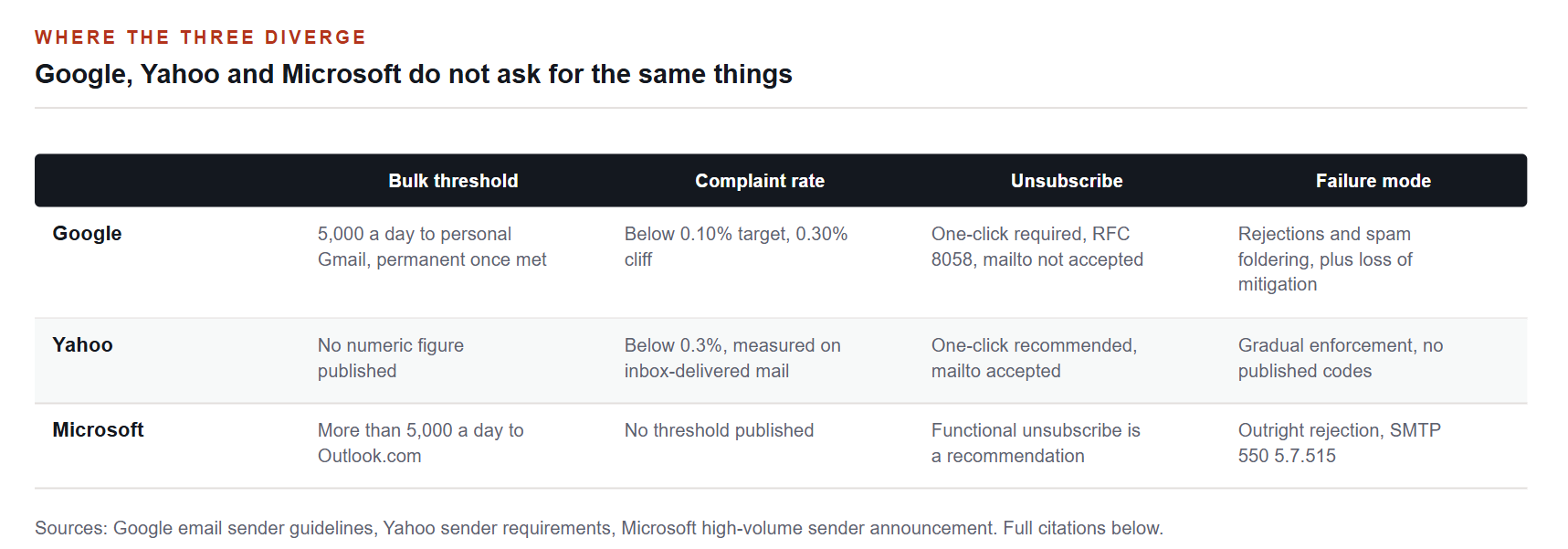
Published requirements as at 30 July 2026. The differences matter operationally: a configuration that satisfies Yahoo can still fail Google, and Microsoft rejects outright rather than junk-foldering.
Sales engagement platforms are almost always compared on what they can do: sequence branching, dialler quality, LinkedIn steps, CRM sync depth, AI drafting. Those matter. None of them matters if the mail does not arrive.
Deliverability used to be a soft criterion because the rules were unwritten. They are written now. Google, Yahoo and Microsoft have all published requirements, with thresholds, and in Microsoft's case with the exact rejection code. That makes deliverability the one criterion in this category you can score objectively, and it should be scored first.
What the three providers actually require
Google. A bulk sender is anyone sending close to 5,000 messages or more to personal Gmail accounts within a 24-hour period, with messages from the same primary domain counting toward that total. The status is permanent: senders who meet the criteria at least once are permanently considered bulk senders.
All senders need SPF or DKIM, valid forward and reverse DNS, and TLS. Bulk senders need SPF, DKIM and DMARC, with the DMARC policy permitted to be set to none, plus alignment of the From domain with either the SPF or the DKIM domain. Only one needs to align.
On complaints, Google's wording is worth reading twice: keep spam rates reported in Postmaster Tools below 0.10 per cent, and avoid ever reaching a spam rate of 0.30 per cent or higher. Bulk senders above 0.30 per cent become ineligible for mitigation, and eligibility returns only after seven consecutive days below that level.
One-click unsubscribe is required for marketing and subscribed messages from senders at 5,000 a day or more, implemented as RFC 8058 headers plus a visible link in the body. A mailto link alone does not satisfy it. Unsubscribe requests should be fulfilled within 48 hours, and failure to do so is listed as a compliance failure.
The date that matters most is not February 2024. It is November 2025, from which Google states it has been ramping up enforcement on non-compliant traffic, with messages that fail the requirements experiencing disruptions including temporary and permanent rejections.
Yahoo. Keep the spam rate below 0.3 per cent, calculated on Yahoo's side from mail delivered to the inbox, which will read lower than your own measurement of the same traffic. All senders need SPF or DKIM. Bulk senders need both, plus a valid DMARC policy of at least p=none that must pass, with relaxed alignment acceptable. Yahoo asks for a functioning list-unsubscribe header supporting one-click, describes the RFC 8058 post method as highly recommended, and explicitly accepts the mailto method. It publishes no numeric definition of a bulk sender.
Microsoft. Domains sending more than 5,000 emails a day to Outlook.com must pass SPF and DKIM and have DMARC at p=none or stronger, aligned with SPF or DKIM and preferably both, enforced from 5 May 2025.
The important detail was a revision. Microsoft's original announcement said non-compliant mail would go to the junk folder. The 30 April 2025 update replaced that with a decision to reject, with the rejected messages designated 550 5.7.515 Access denied, sending domain does not meet the required authentication level. Microsoft's own postmaster policy page still carries the older junk-foldering wording, which is a live contradiction between two Microsoft sources. The blog is the later and more specific one.
The three converge on 5,000 a day and on SPF plus DKIM plus DMARC. They diverge on the two things that actually bite: only Google publishes a 0.1 per cent working target, only Yahoo accepts a mailto unsubscribe, and only Microsoft rejects outright with a named SMTP code.
The eleven controls worth scoring
Score each of these on the platform, not on the vendor's willingness to discuss them.
Hard sending limits. Can a per-mailbox and per-domain daily ceiling be enforced by the platform, or is it advisory? An advisory limit is not a control.
Domain warm-up. Is there a scheduled ramp, and does the platform refuse to exceed it?
Subdomain separation. Does the platform support and encourage sending from a subdomain rather than the primary domain? Ask what its own customers do.
Complaint-rate visibility. Does the platform surface Postmaster Tools spam rate inside the product, or do you have to go and look? A team that has to go and look will not.
Automatic throttling on complaint rise. What happens automatically when the rate crosses 0.1 per cent? If the answer is an email to an admin, that is not a control either.
DMARC alignment management. Does the product verify alignment at setup and re-verify on domain changes?
One-click unsubscribe. RFC 8058 headers, not just a body link, and honoured across every sequence and every mailbox within 48 hours.
Global suppression. Does an unsubscribe suppress across the whole workspace, every sequence and every user, immediately?
List validation before send. Is verification built in or bolted on, and does the platform block a send on a list that fails?
Bounce handling. Are hard bounces suppressed automatically, and is there a threshold at which a sequence stops itself?
Seed and placement testing. Can you test inbox placement across the three providers from inside the product?
The legal layer, which is not the same as the deliverability layer
Passing the mailbox providers' technical requirements does not make outbound lawful. In the United States, CAN-SPAM sets separate requirements on identification, physical address and honouring opt-outs. In the European Union and the United Kingdom, unsolicited electronic marketing sits under the ePrivacy regime alongside the GDPR and UK GDPR, and the position on business-to-business email varies by member state. The UK's guidance in this area is currently under review following the Data (Use and Access) Act 2025.
Two separate compliance regimes, two separate failure modes. A platform that helps with one is not necessarily helping with the other, and vendors routinely conflate them in sales conversations.
How to run the evaluation
Ask each vendor for the Postmaster Tools spam rate trend of three customers at your intended volume, ninety days in. Ask what their product does automatically at 0.1 per cent and at 0.3 per cent. Ask whether their customers send from the primary domain and what they recommend. Ask them to show you a rejection log.
A vendor that can answer those four questions has operated at scale. A vendor that redirects to feature comparison has told you what it does not measure.
What we did not publish. We looked for independent data on B2B inbox placement and bounce rates and did not find any that met our standard. Almost every figure in circulation comes from a deliverability vendor's own dataset with undisclosed sampling. We have used only the mailbox providers' own published requirements, which are checkable by anyone.
This is reporting on rules as they stood at the date of publication. It is not legal advice. Requirements differ by jurisdiction and change. Take qualified advice on your own circumstances.
References
Every figure and legal citation in this article is drawn from the sources below. Where an instrument is proposed rather than in force we say so in the text.
Google, Email sender guidelines. https://support.google.com/mail/answer/81126
Google, Email sender guidelines FAQ. https://support.google.com/a/answer/14229414
Yahoo, Sender requirements and recommendations. https://senders.yahooinc.com/best-practices/
Yahoo, Postmaster blog, an update on enforcing email standards. https://blog.postmaster.yahooinc.com/
Microsoft, Strengthening the email ecosystem: Outlook's new requirements for high-volume senders, published 2 April 2025, updated 30 April 2025. https://techcommunity.microsoft.com/blog/microsoftdefenderforoffice365blog/strengthening-email-ecosystem-outlook%E2%80%99s-new-requirements-for-high%E2%80%90volume-senders/4399730
Microsoft, Outlook.com postmaster policies and announcements. https://sendersupport.olc.protection.outlook.com/pm/policies.aspx
IETF, RFC 8058, signalling one-click functionality for list email headers. https://www.rfc-editor.org/rfc/rfc8058
Information Commissioner's Office, Guide to PECR, under review following the Data (Use and Access) Act 2025, page dated 20 August 2025. https://ico.org.uk/for-organisations/direct-marketing-and-privacy-and-electronic-communications/guide-to-pecr/
How we work. This article was researched and written by the Sales Hub Media editorial team. We do not republish press releases. Every number and legal citation is checked against a primary source, which is named and linked above. Where an instrument is proposed rather than in force, we say so. Corrections are made openly on the article itself, never by silent edit. If you believe something here is wrong, write to info@saleshubmedia.com and tell us what and why.
Filed under Sales Engagement & Outreach · Get The Weekly Brief