
Nobody publishes credible data on approval cycle time. That is not an accident, and it tells you where to look first.
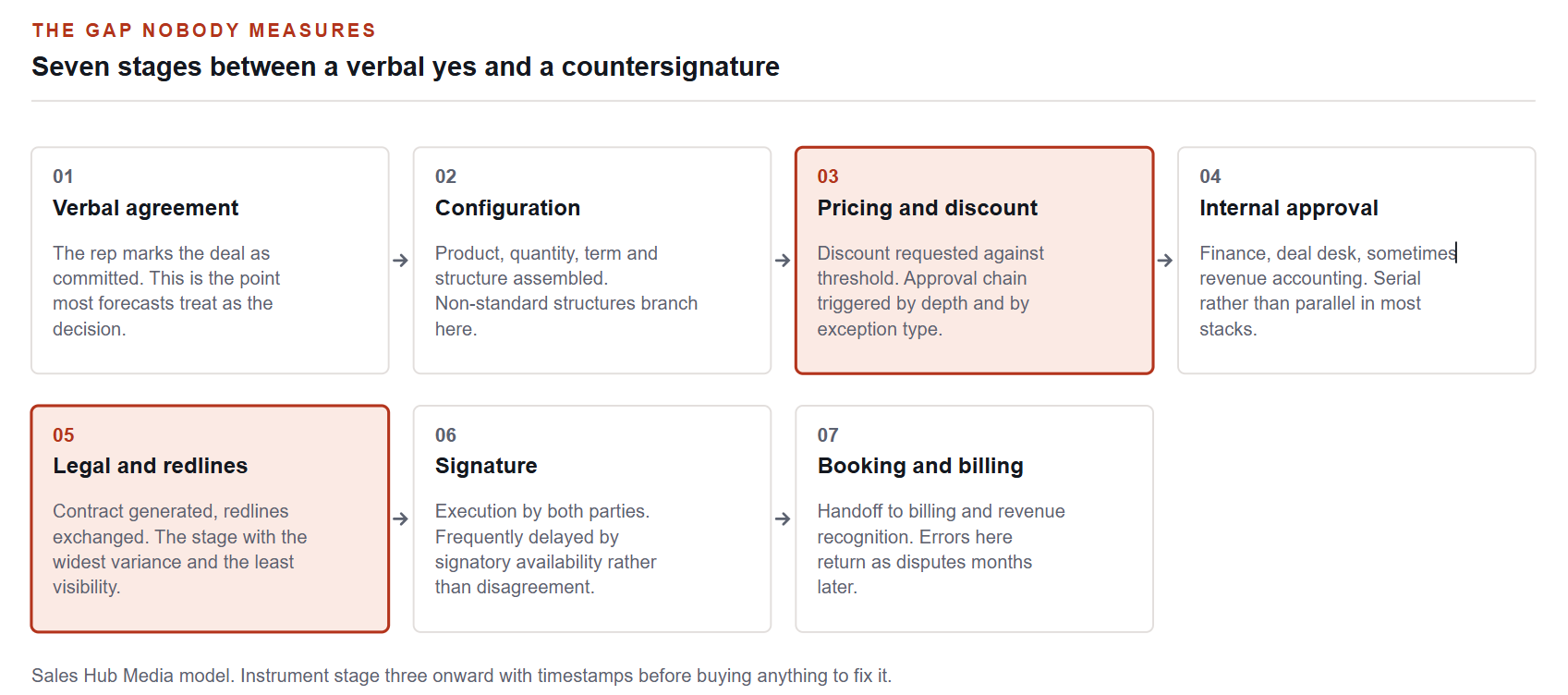
The forecast usually records the first stage and the last. What happens in between is largely uninstrumented, which is why deals slip without anyone being able to say where.
Ask a revenue leader where deals slip and you will hear about the buyer. Ask a deal desk and you will hear something different: that a meaningful share of slipped deals were agreed in the period and did not get through the company's own process in time.
We wanted to put numbers on that. We could not, and the reason is worth stating at the top.
There is no credible published data on any of this
We searched for verified data on quote-to-cash cycle time, approval cycle time, the proportion of deals requiring approval, discount approval thresholds, and CPQ implementation success and failure rates. None of it met a basic standard of a named publisher, a sample size and a date.
Everything in circulation originates in vendor marketing or gated analyst material. That is a striking absence for a process that sits between every closed deal and its revenue, and it has a practical consequence: you cannot benchmark this. You can only instrument it.
A process that nobody has measured publicly is a process where your own instrumentation is immediately best-in-class. That is unusual, and it is an opportunity rather than a problem.
The seven stages, and where the time actually goes
Configuration. Fast when the deal is standard, and the source of most exception volume when it is not. The question worth asking is what proportion of your deals are configured outside the standard catalogue, because that proportion predicts almost everything downstream.
Pricing and discount. The first real approval gate. The failure mode here is rarely the approval itself, it is the chain: thresholds set years ago, approvers who are no longer in the role, and escalation rules that trigger on discount depth without regard to deal size, so a small deal with a large percentage discount consumes more executive attention than a large deal with a small one.
Internal approval. Most stacks run this serially because that is how workflow tools default. Finance, then deal desk, then revenue accounting, each waiting on the last. Parallel approval where the approvals are genuinely independent is usually a configuration change rather than a purchase, and it is the single largest available compression in most deal desks.
Legal and redlines. The widest variance and the least visibility. Contract cycle time is rarely instrumented at all, so the time a deal spends in redlines shows up as a general sense that legal is slow rather than as a measurement anyone can act on.
Signature. Frequently delayed by signatory availability rather than by disagreement, which is a scheduling problem being reported as a commercial one.
Booking and billing. Errors here do not delay the close. They return months later as disputes, credits and revenue adjustments, and they are almost never attributed back to the deal desk.
Why usage-based pricing has made this harder
The structural change worth registering is that deal structures have become harder to price and to book, and the platform vendors have moved in response.
In June 2026 HubSpot launched Revenue Hub, positioned explicitly around bringing quote to cash into one place. In the same month Salesforce agreed to acquire m3ter, a consumption metering and rating company, with completion expected on 1 July 2026 and folding it into its revenue management product, citing the flexible usage and outcome-based pricing models needed for the AI era and automation of monetization flows across CRM, ERP and quote-to-cash systems.
Two platform vendors making the same bet in the same month is a signal about where the friction has moved. Consumption and outcome-based pricing put a metering problem inside a process that was designed for fixed-term subscriptions, and the approval chain was not built for a price that is not known at signature.
The accounting constraint that shapes deal structure
Revenue recognition is not a deal desk detail, it is a boundary condition on what structures are available. IFRS 15, Revenue from Contracts with Customers, was issued by the International Accounting Standards Board in May 2014 and is effective for annual reporting periods beginning on or after 1 January 2018. The converged United States standard, FASB ASC Topic 606, was introduced into the Codification at the same time.
The practical consequence is that non-standard structures involving bundled deliverables, variable consideration, or performance obligations satisfied over different periods require a revenue accounting view before signature rather than after. Deal desks that involve revenue accounting only at booking discover this as a restatement risk.
Instrumenting it, which takes one quarter
Timestamp entry and exit for each of the seven stages. If your stack cannot do that, timestamp entry and exit for approval, legal and signature, which is where the variance lives.
Record the reason for every approval, not just the outcome. Discount depth, non-standard term, custom clause, payment terms. The distribution of reasons is your redesign brief.
Measure serial against parallel time. Work out how much of the approval elapsed time is waiting rather than reviewing.
Track approvals that were never declined. An approval gate that approves everything is a delay with a governance costume on.
Separate signatory delay from negotiation delay. They have completely different fixes.
Report deal desk cycle time in the pipeline review alongside stage age. Once it is visible weekly it starts to move.
Run that for a quarter and you will have better data on your own approval process than exists anywhere in the published literature. Given what the published literature contains, that is a low bar and a high return.
This is reporting on sales technology and revenue operations. It is not procurement, legal or investment advice.
References
Every figure and legal citation in this article is drawn from the sources below. Where an instrument is proposed rather than in force we say so in the text.
IFRS Foundation, IFRS 15 Revenue from Contracts with Customers, issued May 2014, effective 1 January 2018. https://www.ifrs.org/issued-standards/list-of-standards/ifrs-15-revenue-from-contracts-with-customers/
HubSpot, Introducing Revenue Hub: quote to cash, finally in one place, 18 June 2026. https://www.hubspot.com/company-news/introducing-revenue-hub-quote-to-cash-finally-in-one-place
The Bridge Group, AE Models, Motions and Metrics 2026, on increases in discounting pressure and deal slippage, n=158, 22 June 2026. https://www.bridgegroupinc.com/research/2026-ae-models-motions-metrics
How we work. This article was researched and written by the Sales Hub Media editorial team. We do not republish press releases. Every number and legal citation is checked against a primary source, which is named and linked above. Where an instrument is proposed rather than in force, we say so. Corrections are made openly on the article itself, never by silent edit. If you believe something here is wrong, write to info@saleshubmedia.com and tell us what and why.
Filed under CPQ, Billing & Deal Management · Get The Weekly Brief