
The statistic everyone quotes about unused content is a remark made from a conference stage in 2013. It was never a study, and it has never been replicated.
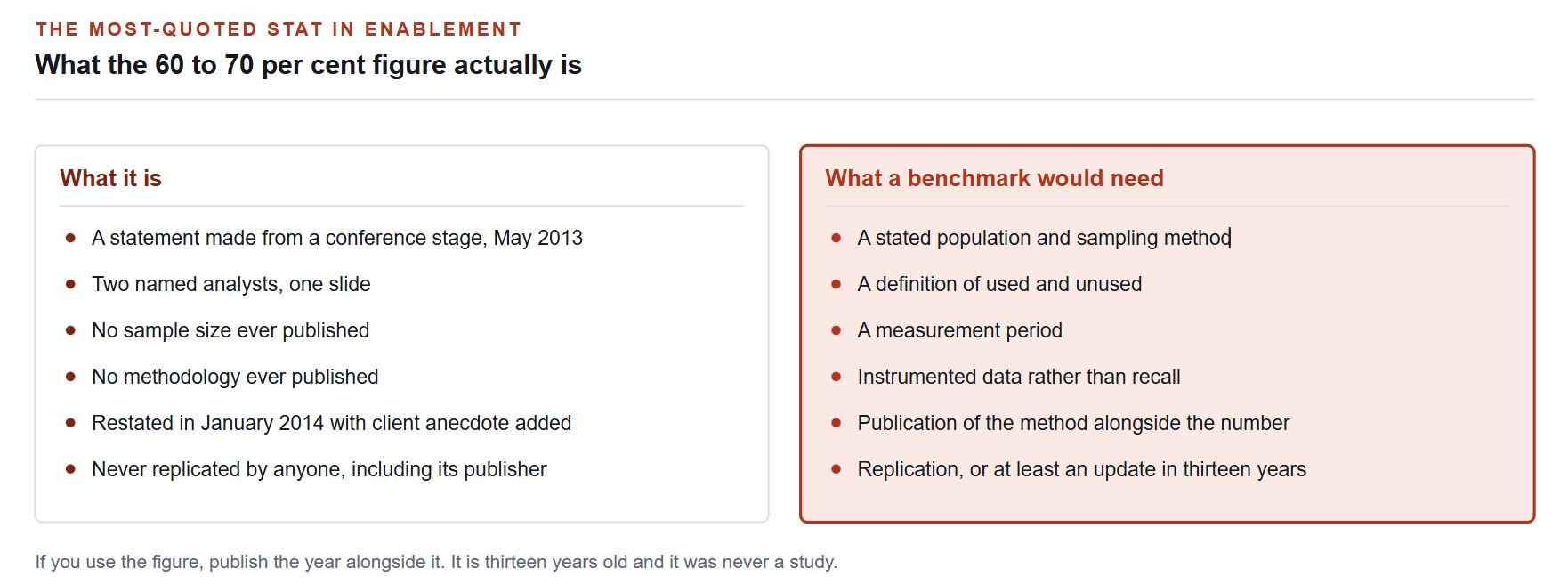
The provenance of the statistic used to justify enablement purchases for more than a decade, set against what would be needed for it to be a benchmark.
If you have ever built a business case for an enablement platform, you have used this number: sixty to seventy per cent of the content marketing produces goes unused.
We traced it. It is not a study. It is a statement made from a conference stage in May 2013 by two analysts, to the effect that 60 to 70 per cent of content churned out by B2B marketing departments sits unused. No sample size was ever published. No methodology was ever published. No fielding period was ever published.
It was restated in January 2014 with an addition that some clients reported more than 80 per cent of their content going unused, which is client anecdote rather than measurement. Attributions of the figure to other research houses are unsupported; we found no primary from any of them.
It has never been replicated. There is no measurement of content utilisation from the last three years that we could verify at all.
A category that has justified more than a decade of purchasing on a single unmeasured remark should expect its buyers to ask harder questions than feature count.
What is actually measurable, and it is inside your own platform
The irony of the unused-content statistic is that every enablement platform sold on the back of it holds the data to answer the question properly. Content opens, shares, time on asset, which assets appear in won deals: all of it is instrumented and none of it is published.
That makes utilisation the right axis for comparing these products, and it is the axis the category avoids. Here is what to ask.
The eight questions
Can you report assets never opened, by author? Not assets with low engagement. Never opened, with the creator named. If the product cannot produce that list, it cannot help you reduce production.
Can you tie asset use to closed won? Not correlation across the library, but which assets appeared in which won deals, at which stage.
What is your monthly active rate among licensed reps? Ask for the distribution across the vendor's own customer base, not the average. The average will be carried by a handful of heavy users.
Where does the rep encounter the content? Inside the CRM record and the email client, or in a separate application they have to remember exists? This single design decision predicts adoption better than any feature.
How long does search take to first useful result? Time it during the demo, on your own content, with a question a new rep would actually ask.
What happens to an asset nobody uses? Is there an expiry, a review trigger, an archive? Libraries that only grow become unusable regardless of the search quality.
Can a rep modify an asset, and is the modification tracked? Reps modify content whether or not the platform allows it. A platform that forbids it produces shadow versions on local drives.
What does the coaching data show about who uses content and who hits quota? The vendor has this. Ask whether it will show you.
The adjacent evidence, with its provenance
Three current figures are worth holding, all vendor-published and labelled as such.
A 2025 enablement study across 350 go-to-market professionals in 21 countries, fielded February to March 2025, found 90 per cent using or planning to use AI for go-to-market, 55 per cent unable to effectively drive go-to-market initiatives, 29 per cent still on disconnected tools, and managers spending thirteen hours a week coaching.
A 2026 follow-up across 450 go-to-market leaders found 98 per cent believing execution is standardised while only 53 per cent report consistent outcomes, an average of nearly six go-to-market initiatives a year of which only 52 per cent are implemented and used consistently, and 76 per cent saying AI adoption outpaces organisational support. Its fielding period is not disclosed.
The largest vendor survey in sales, across 4,050 professionals fielded August to September 2025, found 52 per cent of reps saying traditional enablement does not give them the skills they need, 46 per cent rarely getting feedback on sales conversations, and 75 per cent saying they are more likely to hit target with a coach or mentor.
Read together, those describe a category where the problem has moved. Content supply is solved. Content findability is largely solved. What is not solved is whether any of it changes what happens in a conversation, and no platform in the category publishes evidence that it does.
The historical baseline, for what it is worth
The 2019 enablement study across 918 organisations found 61.3 per cent had an enablement person, function or initiative, up from 19.3 per cent in 2013, ranging from 39.3 per cent at organisations with fewer than 25 sellers to 77.1 per cent at those with more than 500. It also found only 31.8 per cent had a developed and implemented content strategy, and 28.1 per cent did not know what they spent on seller content.
That last figure is the one to sit with. More than a quarter of organisations could not say what they spent on the thing the sixty-to-seventy per cent statistic claims they were wasting.
How to run the evaluation
Load your own content into the trial, not the vendor's sample library. Give three reps a question each and time the search. Ask for the never-opened report on day one of the pilot rather than at renewal. And agree, before you buy, what utilisation rate would cause you not to renew.
The category will not give you a benchmark to measure against, because it does not have one. Your own baseline, measured before deployment, is the only comparison available, and it is a better one anyway.
This is reporting on published benchmark data. We state which sources are independent and which are vendor-published. It is not procurement advice.
References
Every figure and legal citation in this article is drawn from the sources below. Where an instrument is proposed rather than in force we say so in the text.
Forrester, formerly SiriusDecisions, Summit 2013 highlights: inciting a B2B content revolution, the origin of the unused-content figure, May 2013. https://www.forrester.com/blogs/summit-2013-highlights-inciting-a-btob-content-revolution/
Forrester, formerly SiriusDecisions, It's not content, it's a lack of buyer insights that's the problem, restating the figure, 29 January 2014. https://www.forrester.com/blogs/its-not-content-its-a-lack-of-buyer-insights-thats-the-problem/
Highspot, State of Sales Enablement 2025, 11th edition, n=350, fielded February to March 2025, vendor-published, 2025. https://www.highspot.com/state-of-sales-enablement-2025/
Salesforce, State of Sales, 7th edition, n=4,050, fielded August to September 2025, vendor-published, 2026. https://www.salesforce.com/en-us/wp-content/uploads/sites/4/documents/reports/sales/salesforce-state-of-sales-report-2026.pdf
CSO Insights, Miller Heiman Group, 5th Annual Sales Enablement Study, n=918, fielded May to June 2019, October 2019. https://salesenablement.pro/assets/2019/10/CSO-Insights-5th-Annual-Sales-Enablement-Study.pdf
How we work. This article was researched and written by the Sales Hub Media editorial team. We do not republish press releases. Every number and legal citation is checked against a primary source, which is named and linked above. Where an instrument is proposed rather than in force, we say so. Corrections are made openly on the article itself, never by silent edit. If you believe something here is wrong, write to info@saleshubmedia.com and tell us what and why.
Filed under Enablement, Coaching & Readiness · Get The Weekly Brief