
This category is the most over-promised in B2B software. Five questions separate the products that survive contact with a real territory.
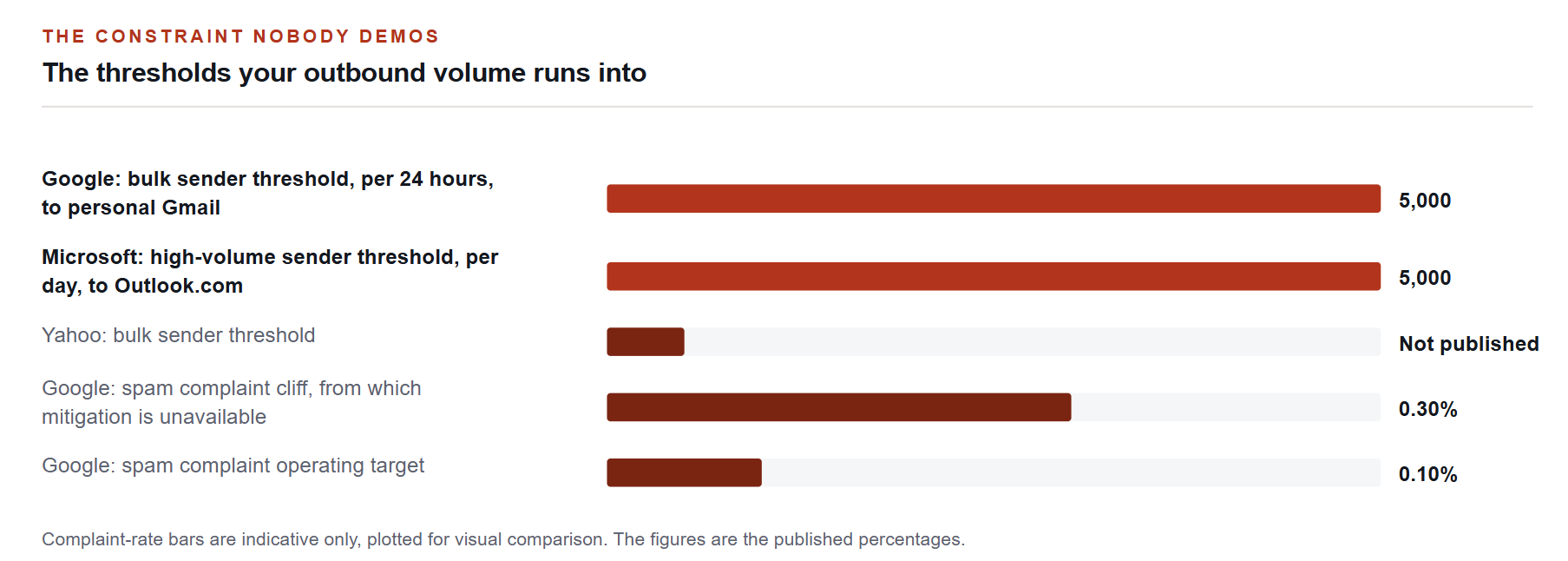
Published requirements from the three mailbox providers that matter most in B2B. Bars show the daily-volume threshold at which bulk sender rules apply. Google and Microsoft both set it at 5,000 messages a day to their consumer domains; Yahoo publishes no numeric figure.
No category in sales technology has been sold harder than the autonomous SDR. The pitch is straightforward and genuinely appealing: software that researches accounts, writes the outreach, sends it, handles the reply and books the meeting, at a fraction of the cost of a person.
Some of that works. Some of it works only under conditions the demo does not mention. The gap between the two is where budget disappears, and it is entirely knowable in advance if you ask the right things.
1. What happens to deliverability at volume
This is the question that decides whether the rest matters. Sending capacity is not a software problem, it is a domain reputation problem, and reputation degrades when volume rises faster than engagement.
The mailbox providers have now written the limits down, which makes this the easiest of the five questions to test. Google defines a bulk sender as anyone sending close to 5,000 messages or more to personal Gmail accounts within a 24-hour period, counts messages from the same primary domain toward that total, and states that senders who meet the criteria at least once are permanently considered bulk senders. Microsoft applies its high-volume requirements to domains sending more than 5,000 emails a day to Outlook.com.
Google's guidance on complaints is specific and it is stricter than most teams assume: keep spam rates reported in Postmaster Tools below 0.10 per cent, and avoid ever reaching 0.30 per cent or higher. Above 0.30 per cent a bulk sender becomes ineligible for mitigation, and eligibility returns only when the rate stays below that level for seven consecutive days. Yahoo's published requirement is to keep the spam rate below 0.3 per cent, calculated on its side from mail delivered to the inbox, which will read lower than your own measurement.
Ask the vendor what its customers' Postmaster Tools spam rates look like after ninety days at target volume. A vendor that has never looked at that number has not thought seriously about the problem it is selling into.
Ask how the product manages sending volume, whether it warms domains, whether it enforces limits, and what happens to reputation metrics in accounts that have scaled up. Ask specifically whether customers run these tools on their primary domain, and what the vendor recommends.
2. Where does the research come from
Personalisation at scale requires a source of information about each account. Ask what that source is.
If it is public web content, output quality will track how much a company publishes, which means it degrades exactly where you need it most: mid-market accounts with thin web presence. If it is a licensed data provider, ask which one, because you may already pay for it. If the answer is vague, treat the personalisation claim as unproven.
3. What is the actual human handoff
Most teams that succeed with these tools use them for the top of the funnel and hand off early. Most teams that struggle attempted full automation through to the meeting.
Ask where the product expects the handoff, what the reply-handling logic does when a prospect asks something unexpected, and how a rep takes over a conversation mid-thread without the prospect noticing a change of voice.
There is a buyer-side reason to hand off early. In 6sense's 2025 buyer experience research, drawn from just under 4,000 responses, 94 to 95 per cent of buying groups ranked their shortlist in order of preference before contacting any seller, and where a leader existed at first contact that leader won nearly 80 per cent of the time. That is a vendor-sponsored study and should be read as such, but it points at something the AI SDR pitch tends to skip: by the time a reply arrives, the conversation is usually further along than the sequence assumes.
4. How is quality measured, and by whom
Meetings booked is not a sufficient metric, because it can be inflated by low-quality meetings that waste rep time and quietly reduce productivity.
The metrics worth tracking are meetings held, meetings converted to opportunity, and reps' own quality assessment. Agree those before the pilot rather than after, because the vendor will otherwise define success for you.
One benchmark is worth holding in mind while you set the bar. ICONIQ's 2026 go-to-market research found that companies with more than half of pipeline AI-influenced showed conversion gains of eleven percentage points from new lead to MQL and eight points from MQL to SQL, but only one point from SQL to closed won. Their own reading was that AI provides account executives with more, better-qualified opportunities but does not currently change outcomes once a deal is in an active cycle. If that holds for you, the value is real and it is concentrated at the top of the funnel, which is precisely where you should be measuring.
5. What does turning it off look like
Ask what happens to sequences, contact records and reply history if you stop paying. Data portability is unglamorous and it is exactly what you want to know before you route a meaningful share of outbound through a third party.
The honest position
These tools are neither the revolution nor the fraud they are variously presented as. They automate a genuine bottleneck and they introduce genuine risk to a channel that most B2B companies cannot easily replace.
Buy them with the deliverability question answered first, the handoff designed deliberately, and a definition of success that a rep would recognise.
Before the pilot: agree the metric, agree the volume ceiling, agree the domain it sends from, and agree the date you will decide.
This is reporting on sales technology and revenue operations. It is not procurement, legal or investment advice.
References
Every figure and legal citation in this article is drawn from the sources below. Where an instrument is proposed rather than in force we say so in the text.
Google, Email sender guidelines. https://support.google.com/mail/answer/81126
Google, Email sender guidelines FAQ. https://support.google.com/a/answer/14229414
Yahoo, Sender requirements and recommendations. https://senders.yahooinc.com/best-practices/
Microsoft, Strengthening the email ecosystem: Outlook's new requirements for high-volume senders, published 2 April 2025, updated 30 April 2025. https://techcommunity.microsoft.com/blog/microsoftdefenderforoffice365blog/strengthening-email-ecosystem-outlook%E2%80%99s-new-requirements-for-high%E2%80%90volume-senders/4399730
6sense, The 2025 B2B Buyer Experience Report, vendor-sponsored, just under 4,000 responses, November 2025. https://6sense.com/science-of-b2b/buyer-experience-report-2025/
ICONIQ, The State of Go-to-Market in 2026, survey fielded January 2026, March 2026. https://www.iconiqcapital.com/growth/reports
How we work. This article was researched and written by the Sales Hub Media editorial team. We do not republish press releases. Every number and legal citation is checked against a primary source, which is named and linked above. Where an instrument is proposed rather than in force, we say so. Corrections are made openly on the article itself, never by silent edit. If you believe something here is wrong, write to info@saleshubmedia.com and tell us what and why.
Filed under AI Selling & Sales Agents · Get The Weekly Brief