
The published data does not show abandonment. It shows something more useful: gains that are real at the top of the funnel and close to zero once a deal is live.
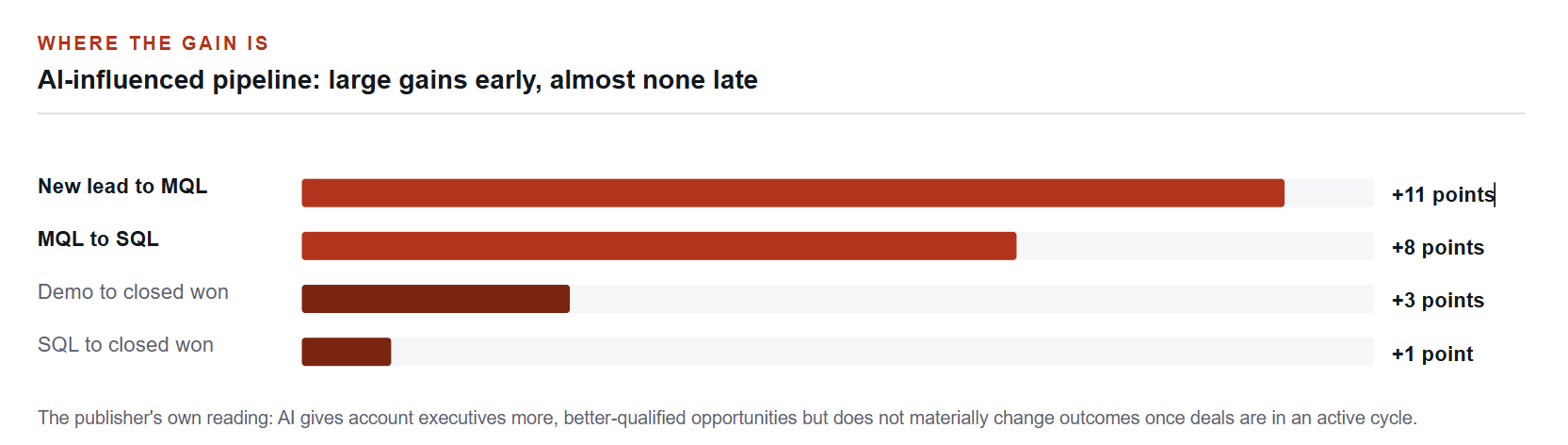
Conversion-rate difference in percentage points for companies with more than half of pipeline AI-influenced, against those without. ICONIQ, The State of Go-to-Market in 2026, survey fielded January 2026, n=147.
We set out to report on teams quietly switching AI selling tools off. The honest finding is that the published evidence does not establish a wave of abandonment. What it does establish is more useful to anyone deciding where to spend.
The gains are real, and they are concentrated
ICONIQ's 2026 go-to-market research, fielded in January 2026 across 147 B2B software companies, compared companies with more than half of pipeline AI-influenced against the rest. Conversion from new lead to MQL was eleven percentage points higher. MQL to SQL was eight points higher. Demo to closed won was three points higher. SQL to closed won was one point higher.
The publisher's own conclusion is the sentence to take away: AI provides account executives with more, better-qualified opportunities, but currently does not materially change outcomes once deals are in an active cycle.
Eleven points at the top of the funnel and one point at the bottom is not a disappointing result. It is a precise instruction about where to deploy and where to stop.
The Bridge Group's 2026 account executive research points the same way from a different angle. Companies in the highest tercile of AI engagement reported 57 per cent of reps at quota against 39 per cent in the lowest. The publisher pre-specified the terciles before examining outcomes and tested three negative controls, which is better practice than almost anything else in this space, and it states plainly that this is observational data and that it is not claiming causation. Self-selection into AI adoption is real: the companies furthest ahead on AI are not otherwise average companies.
Adoption skews to size, not to youth
The pattern in adjacent adoption data is consistent and counterintuitive. In the 2026 advisory-technology survey covering 2,906 respondents, AI notetaking adoption ran above 43 per cent at firms with more than $8 million in annual revenue against 32 per cent at the smallest, and practitioners with twenty years of experience were marginally more likely to use these tools than those with one to five years.
The constraint is not enthusiasm. It is the operational capacity to deploy, integrate and govern, which larger organisations have and smaller ones do not.
The four patterns that precede a tool being turned off
No published dataset tracks abandonment. What follows is drawn from the failure conditions the evidence does describe, and each is testable before you buy.
One: the deliverability blast radius. This is the only failure in the category that damages an asset you cannot easily replace. Google now defines a bulk sender as anyone sending close to 5,000 messages a day to personal Gmail accounts and treats that status as permanent once met. It asks senders to stay below a 0.10 per cent spam complaint rate and states that above 0.30 per cent a bulk sender becomes ineligible for mitigation until the rate stays below that level for seven consecutive days. From November 2025 it has been ramping enforcement, with non-compliant traffic experiencing temporary and permanent rejections. Microsoft rejects outright with a named SMTP code. A tool that raises volume faster than engagement will find those limits, and the domain damage outlasts the subscription.
Two: the quality metric nobody agreed. If the pilot is measured on meetings booked, it will produce meetings booked. Meetings held, meetings converted to opportunity and rep-assessed quality are the metrics that survive contact with a territory, and they have to be agreed before the pilot rather than negotiated after it.
Three: research that degrades where you need it. Tools that personalise from public web content produce output quality proportional to how much a company publishes. That is strongest at large enterprises you were already covering and weakest in the mid-market, which is usually the reason the tool was bought.
Four: automation carried too far down the funnel. This follows directly from the conversion data. If the measured gain between SQL and closed won is one point, automating that stage is spending money where the evidence says there is nothing to gain, while adding risk to conversations that are already commercially live.
The buyer-side reason to hand off early
6sense's 2025 buyer research, drawn from just under 4,000 responses, found that 94 to 95 per cent of buying groups ranked their shortlist in order of preference before contacting any seller, and that where a leader existed at first contact that leader won nearly 80 per cent of the time. Where buyers had not identified a leader, the first vendor they spoke to won 57 per cent of the time.
It is a vendor-sponsored study and should be read as such, including the fact that the vendor sells software designed to detect buyers during the anonymous phase. The implication still holds: by the time a reply arrives, the conversation is usually further along than the sequence assumes, which is an argument for handing off early rather than automating further.
How to decide whether to keep it
Measure your Postmaster Tools spam rate weekly from day one of any pilot. It is the leading indicator for the only irreversible failure.
Report gains by funnel stage rather than in aggregate. An aggregate number will hide the fact that all the value is early.
Compare against the segment the tool was bought to cover. Enterprise performance will flatter a tool bought for mid-market.
Agree the shutdown criteria in advance, in writing, alongside the success criteria. Very few pilots have them, which is why so few end.
Ask what happens to sequences, contacts and reply history on termination. Portability is the cost of changing your mind.
What we could not verify. We found no dated, named study quantifying abandonment or churn of AI selling tools, and no verified account of a named company reversing a deployment. We are reporting that as an absence rather than inferring from it. Anyone claiming a specific abandonment rate should be asked for the sample.
This is reporting on published benchmark data. We state which sources are independent and which are vendor-published. It is not procurement advice.
References
Every figure and legal citation in this article is drawn from the sources below. Where an instrument is proposed rather than in force we say so in the text.
ICONIQ, The State of Go-to-Market in 2026, survey fielded January 2026, n=147, March 2026. https://www.iconiqcapital.com/growth/reports
The Bridge Group, AE Models, Motions and Metrics 2026, AI engagement terciles, n=158, 22 June 2026. https://www.bridgegroupinc.com/research/2026-ae-models-motions-metrics
Google, Email sender guidelines, bulk sender thresholds and enforcement. https://support.google.com/mail/answer/81126
Microsoft, Outlook's new requirements for high-volume senders, published 2 April 2025, updated 30 April 2025. https://techcommunity.microsoft.com/blog/microsoftdefenderforoffice365blog/strengthening-email-ecosystem-outlook%E2%80%99s-new-requirements-for-high%E2%80%90volume-senders/4399730
6sense, The 2025 B2B Buyer Experience Report, vendor-sponsored, just under 4,000 responses, November 2025. https://6sense.com/science-of-b2b/buyer-experience-report-2025/
Business Wire, Key wealthtech and AI findings from the 2026 T3 and Inside Information Software Survey, n=2,906, cited for cross-sector AI adoption pattern, 10 March 2026. https://www.businesswire.com/news/home/20260310790990/en/Live-from-T3-Key-Wealthtech-and-AI-Findings-from-the-2026-T3-Inside-Information-Software-Survey
How we work. This article was researched and written by the Sales Hub Media editorial team. We do not republish press releases. Every number and legal citation is checked against a primary source, which is named and linked above. Where an instrument is proposed rather than in force, we say so. Corrections are made openly on the article itself, never by silent edit. If you believe something here is wrong, write to info@saleshubmedia.com and tell us what and why.
Filed under AI Selling & Sales Agents · Get The Weekly Brief