
Intent data is useful and routinely oversold. Knowing which type you are buying explains most of the disappointment.
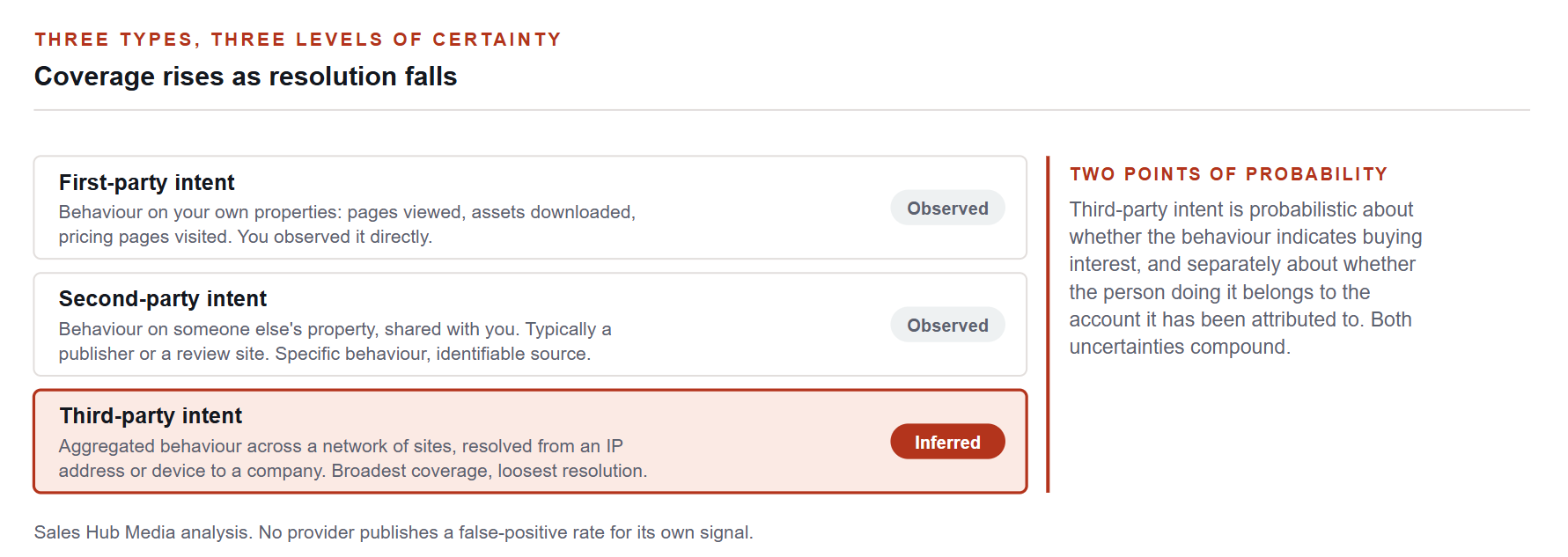
The trade-off that explains most intent data disappointment. Coverage and certainty move in opposite directions, and the type with the widest coverage is probabilistic at two separate points.
Intent data has an unusual problem for a technology category. It works, but it rarely works in the way buyers expect, and the gap between expectation and mechanism produces a great deal of unnecessary disappointment.
The expectation is that intent data tells you which accounts are in market. The mechanism is that it tells you which accounts have shown a pattern of behaviour that correlates with being in market. That is not the same claim, and the difference explains almost everything about how these tools should be used.
Forrester found the same gap when it surveyed the market. In its Q1 2023 global intent data survey, more than 85 per cent of companies using intent data reported business benefits, and more than 70 per cent used multiple providers with almost half using three or more. But Forrester also reported that more companies expected benefits than achieved them, across all benefits surveyed, and that the shortfall was most pronounced in sales use cases and revenue growth.
The three types, and what each actually observes
First-party intent is behaviour on your own properties. It is the most reliable because you observed it directly, and the most limited because it only covers accounts already aware of you.
Second-party intent is behaviour observed on someone else's property and shared with you, typically a publisher or review site. A named account reading a comparison guide in your category is a meaningful signal, because the behaviour is specific and the source is identifiable.
Third-party intent is aggregated behaviour observed across a network of sites, usually resolved from an IP address or device to a company. It offers the broadest coverage and the loosest resolution.
The resolution problem is real, and only one vendor has said so out loud
Most third-party intent depends on resolving an address to an organisation. Bombora, which is the largest supplier of co-operative intent data, has publicly acknowledged that single-vendor identity-graph approaches yield a fair amount of false positives, adding that it knows because it has evaluated them all. It attaches no number to that, and it publishes no false-positive rate, precision figure or match rate for its own signal either.
That is the state of disclosure across the whole category. No provider publishes an accuracy rate. There is no accreditation, no industry standard and no independent audit covering B2B intent signal accuracy. The IAB Tech Lab's data transparency label certifies that a provider discloses how a segment was built, not that the segment is correct.
There is rigorous independent work on the underlying address layer, though it is about geolocation rather than company resolution and should not be presented as a match rate. A 2026 Virginia Tech study of 37,302 observations across 175 countries found median geolocation error of 179 to 207 kilometres on mobile networks against 3 to 16 kilometres on fixed, with failure rates above 100 kilometres running at 53 to 61 per cent in Asia and 66 to 72 per cent in Africa against 9 to 20 per cent in Europe. It is a different measurement from the one intent vendors perform. It is a reasonable prompt to ask harder questions about coverage claims outside North America and Western Europe.
What the signal cannot do
It cannot tell you who in the account is interested. Account-level intent identifies an organisation, not a buying committee member, which is why intent data alone rarely produces a callable list. Forrester's survey found precisely this to be the top execution challenge: identifying which contacts inside a flagged account to target, because few providers deliver signals from known contacts.
It cannot tell you where in the process they are. And it cannot tell you whether the researcher has any budget or authority, which is why some of the strongest apparent signals resolve to students, consultants or competitors.
How teams use it well
The teams that get value treat intent as a prioritisation input rather than a trigger. It reorders a list they were going to work anyway, rather than generating a new list to work blindly. They combine it with fit, because an in-market account outside your ICP is not an opportunity. And they resist the temptation to reference the signal in outreach itself, which reads as surveillance rather than relevance.
The most common operational failure is routing raw intent to reps without interpretation. A rep who calls three accounts flagged as surging and finds nobody who recognises the topic will stop trusting the feed permanently, and that trust does not come back.
Questions for a provider
What is actually observed, and where? Not what is inferred, what is observed.
How is a behaviour resolved to a company, and what is the confidence level of that resolution?
What does a baseline look like? Surging is a comparison against a baseline you should understand.
What is your false positive rate, and how did you measure it? Expect not to get an answer, and note the answer you do get.
Will you run a sample against accounts we already know are in a buying process?
That last one is the only test that tells you whether the signal reflects your reality. Forrester tells buyers the same thing in its evaluation guidance: determine signal accuracy yourself, measure overlap with your existing sources yourself, and do it through a narrow-keyword proof of concept validated against accounts you already know well. When an analyst house tells buyers to go and measure it themselves, that is a statement about what the vendors have not published.
Intent data makes a good list better. It does not make a bad list good, and it does not replace the work of finding the human being.
This is reporting on sales technology and revenue operations. It is not procurement, legal or investment advice.
References
Every figure and legal citation in this article is drawn from the sources below. Where an instrument is proposed rather than in force we say so in the text.
Forrester, Intent data expectations versus reality: what's working and where are the gaps, on the Q1 2023 Global B2B Intent Data Survey, 26 October 2023. https://www.forrester.com/blogs/intent-data-expectations-vs-reality-whats-working-and-where-are-the-gaps/
Forrester, How to evaluate intent data providers, 1 July 2025. https://www.forrester.com/blogs/how-to-evaluate-intent-data-providers/
Bombora, Company Surge intent data still works despite challenges like remote work and the cookieless future, 28 October 2021. https://bombora.com/blog/bomboras-company-surge-intent-data-still-works-despite-challenges-like-remote-work-and-the-cookieless-future/
Nabi et al., Virginia Tech, Lost in the prefix: revisiting IP geolocation accuracy across networks and geographies, arXiv:2605.21937, 21 May 2026. https://arxiv.org/abs/2605.21937
IAB Tech Lab, Data Transparency Standard and label. https://iabtechlab.com/standards/data-transparency/
How we work. This article was researched and written by the Sales Hub Media editorial team. We do not republish press releases. Every number and legal citation is checked against a primary source, which is named and linked above. Where an instrument is proposed rather than in force, we say so. Corrections are made openly on the article itself, never by silent edit. If you believe something here is wrong, write to info@saleshubmedia.com and tell us what and why.
Filed under Intent Data & Buying Signals · Get The Weekly Brief
Sales Hub Media
AboutContactThe Weekly BriefCorrections