
Buying groups now arrive with a shortlist and a preferred vendor already in place. The published evidence on how early that happens is better than most of what this industry cites, and it argues against almost everything sales teams do first.
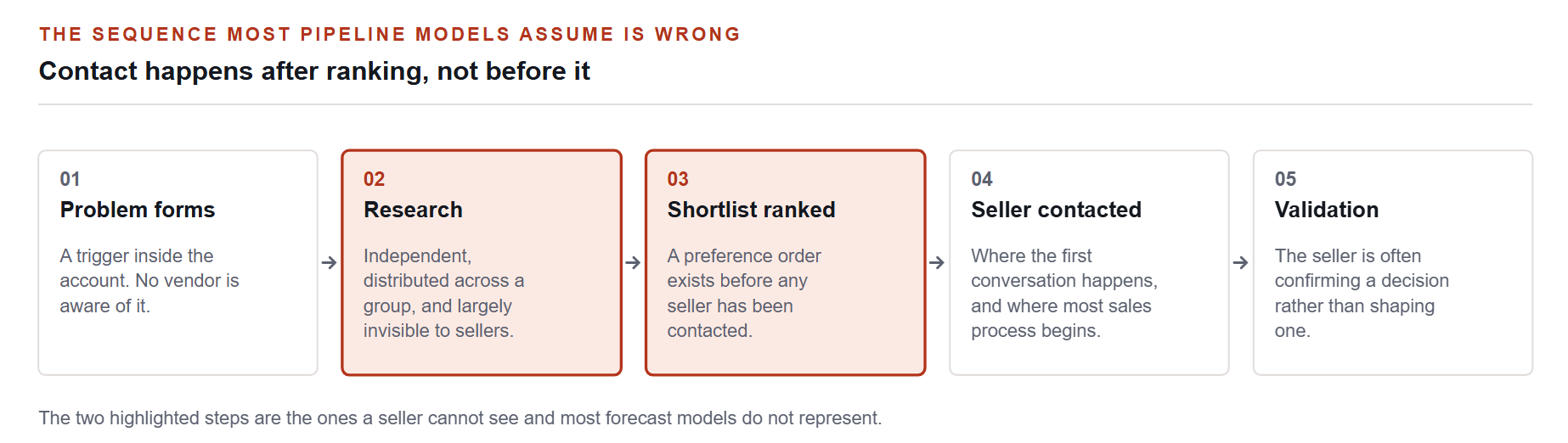
The commercial consequence is that most of what a seller controls happens after the decision that matters has already been provisionally made.
There is a claim in circulation that the modern B2B buyer completes most of the purchase journey before speaking to a vendor. It is usually attached to a percentage, and the percentage is usually untraceable.
The underlying observation is nonetheless supported, and by better evidence than most things this industry repeats. It is worth separating what holds from what does not.
What the evidence supports
Research from 6sense across a sample of roughly four thousand buying decisions found that the overwhelming majority of buying groups have ranked a shortlist before contacting any seller. Where a preferred vendor already exists at that point, it wins the deal in the substantial majority of cases.
The same body of work reports the buyer's own cycle shortening, from around 11.3 months to around 10.1, while the point of first contact with a seller moved six to seven weeks later in the process.
Those two findings together produce the effect most revenue teams are actually experiencing: buyer cycles are getting shorter while seller-visible cycles are getting longer. The deal is not slowing down. The part you can see is starting later.
That reframing matters for forecasting. A lengthening seller-visible cycle is usually read as deterioration in qualification or in rep performance. On this evidence it can occur while buyer behaviour improves, which means the metric is measuring visibility rather than health.
What the evidence does not support
It does not support the widely quoted claim that a fixed percentage of the journey is complete before contact. The number varies by category, by deal size and by whether the buyer has bought in the category before, and the versions in circulation carry no method.
It does not support the inference that sellers are irrelevant. Gartner's work on rep-free preference is frequently cited to that conclusion, and its own follow-up findings run the other way: a majority of buyers turn to a representative specifically to validate what they have learned independently. Preference for a rep-free process is not the same as a rep-free outcome.
And it does not support the most common operational response, which is to increase outbound volume at the point of first contact. If ranking has already happened, arriving louder at the moment of contact competes for a position that has largely been assigned.
What follows for a revenue team
Three consequences, in order of how much they change.
Being on the shortlist is upstream of everything. The activity that determines whether a vendor is in the consideration set happens during the research phase, which is the phase no seller can see. That is an argument for presence in the places a buying group researches, not for more contact attempts once they surface.
The buying group is the unit, not the contact. Research is distributed across several people who rarely coordinate their reading. A single engaged contact inside an account tells you very little about whether the group is in motion, which is the structural weakness of lead-based pipeline models.
Where an incumbent preference exists, the honest question changes. If a preferred vendor is already ranked first, the useful qualification question is not whether the buyer has budget. It is whether there is a reason the current preference would be displaced. Most deals lost late were provisionally lost early.
The measurement worth adding
One number is more useful here than any intent product, and almost nobody records it: at first contact, did the buyer already have a shortlist, and were we on it?
It is a two-field addition to a discovery template. Recorded across a quarter, it tells you what proportion of your pipeline you are entering already ranked, and whether your position improves or degrades between first contact and close. Neither question is answerable from anything currently in most CRMs.
One caution on intent data as the answer to this. No vendor, analyst or academic source publishes a conversion rate from intent-flagged account to opportunity. We looked for it specifically and it does not exist. That absence should temper what any buyer expects from the category, and it is a reasonable question to put to a vendor before purchase.
The broader point is that the part of the process that decides most outcomes is the part sellers cannot observe, and the correct response to an invisible process is to be present in it rather than to arrive at the end of it with more energy.
This is reporting on sales technology and revenue operations. It is not legal, procurement or investment advice.
References
Every figure and legal citation in this article is drawn from the sources below. Where an instrument is proposed rather than in force we say so in the text.
6sense, B2B buyer experience research, shortlist formation and preferred vendor outcomes, 2026. https://6sense.com/resources/
Gartner, B2B buying research on rep-free preference, March 2026. https://www.gartner.com/en/sales/insights/b2b-buying-journey
Gartner, Follow-up research on buyers using representatives to validate independently gathered information, May 2026. https://www.gartner.com/en/sales/insights/b2b-buying-journey
How we work. This article was researched and written by the Sales Hub Media editorial team. We do not republish press releases. Every number and legal citation is checked against a primary source, which is named and linked above. Where an instrument is proposed rather than in force, we say so. Corrections are made openly on the article itself, never by silent edit. If you believe something here is wrong, write to info@saleshubmedia.com and tell us what and why.
Filed under Buyer Behaviour & Intent · Get The Weekly Brief